


Five composers in search of a film producer
Meet the Composer, a new blind-dating initiative for composers at Mostra de València’s Co-production Forum
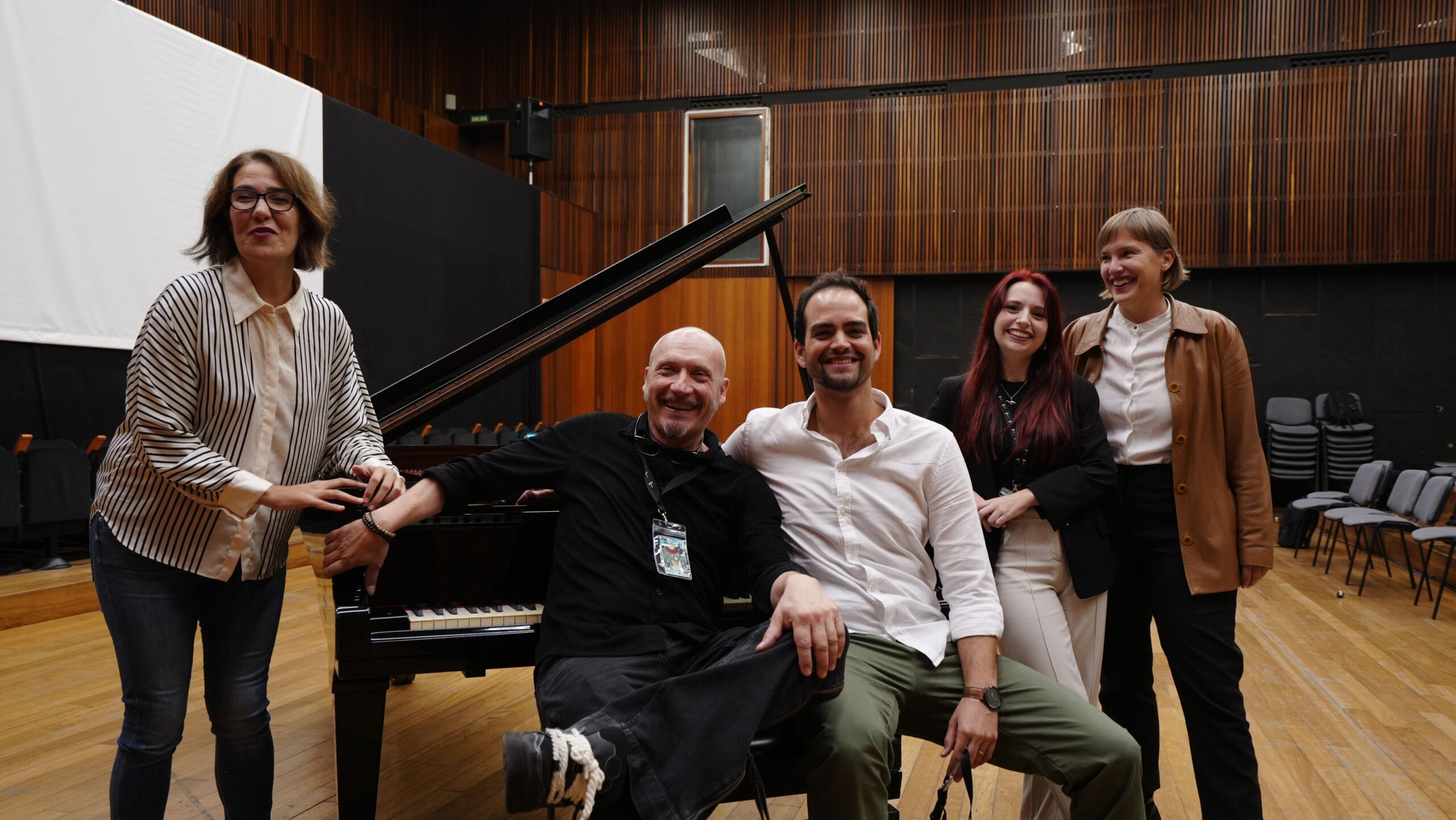
Ten minutes. A grand piano, a projector and a room filled with producers from Tunisia, France, Lebanon, Egypt, Belgium, Germany and Catalonia, alongside a strong contingent from Valencia’s audiovisual industry. This was the blind date that Isabel Latorre, Tomás Santibáñez, Nerea Herreros, Manel Brancal and Isabel Royán faced this afternoon in the Palau de la Música’s Sala García Navarro. They were the five composers selected for the inaugural Meet the Composer, the new initiative through which València Film Afers, the Mostra’s co-production forum, opens its doors to film music for the first time. Each faced the same challenge: to win over someone who could offer them their next film, and each chose a different strategy. Unlike other initiatives at European festivals, this format brings composers face to face with producers while projects are still in development.
Five ways to win over a producer
Tomás Santibáñez began without preamble, with a scene: characters running for their lives, accompanied by screeching strings over a bed of synthesisers. “The bow was completely wrecked by the end of the recording session,” admitted the Chilean-Spanish composer based in Valencia, whose credits include ‘Respira’ and ‘Barrio Esperanza’. His presentation offered a candid look inside his workshop: an acoustic guitar and an aged piano conversing in a woodland house, his daughter’s toys turned into percussion instruments, and Indian scales he learnt on the fly for a mythology podcast. His guiding principle, reassuring for any director: “Dialogue is king; musicians must never get in its way.” He also had an ace up his sleeve: that very morning, he had learnt that ‘Latido’ had just won the Audience Award at Chile’s SANFIC festival.
Isabel Royán, by contrast, chose to keep her résumé — more than fifty works and credits including ‘Paraíso en llamas’ and ‘Alimañas’ — in the background. “It isn’t easy to talk about our own music,” she admitted, before offering something more valuable to a producer: a working method. Four principles, delivered like a manifesto: create a unique sonic world for each film; keep the story at the centre; explore sound without being afraid to blend electronic and acoustic elements; and nurture a good working relationship within the team, “especially because composers tend to arrive when the pressure is mounting in post-production”. Music, she reminded the audience, “can conceal, reveal and even mislead the viewer”. Then she let her showreel speak for her.
Nerea Herreros took the most direct approach: a carefully structured portfolio spanning film and video games. The Madrid-born composer and violinist presented the string quartet recording for the Basque documentary ‘Dark Eta Biok’, which she herself conducted in the studio, before moving through post-war Madrid in ‘Tears for Clavel’ and the epic humour of ‘Aard and Wyzz’. A Women in Games ambassador, she took the opportunity to challenge stereotypes — “video games are one of the most complete art forms” — and ended as any good date should: with a QR code on screen and an invitation to keep the conversation going.
Manel Brancal, a sound engineer and technical director of the Universitat Jaume I’s Paranimf, invited the audience to listen. Piece by piece, he explained what the music needed to convey: love at first sight, when time stands still; a child imagining his imprisoned father escaping through the ceiling of his cell with the help of sunflowers; the melancholy of ‘Enxofre’. He then revealed his most personal offering, drawing on his training with Jorge Pardo and Carles Benavent: an arrangement of Tárrega’s ‘Capricho árabe’ in a 6/8 tanguillos rhythm for a flamenco-jazz band.
Isabel Latorre, finally, turned her presentation into a self-portrait of an all-round musician. On screen, the Valencian composer appeared learning vocal polyphony in Georgia, improvising with accordion and electronics, playing trombone in her hometown band and drums in a punk group. “This is no coincidence,” she explained: each musical language is a tool for a profession that demands a change of style with every film. She advocated working with directors from pre-production, because “music can influence the narrative, even the screenplay”, and announced her three appearances at the festival, from ‘Facundo Martínez, de Mislata a Kioto’ to ‘La violinista’. Then she sat at the grand piano and sang in Valencian “as a gift for those of you visiting from elsewhere”. Meet the Composer’s first date ended with applause.
A different kind of encounter
Meetings between composers and filmmakers are nothing new on the international circuit, but they tend to take place in more closed formats. Since 2020, Cannes’ Marché du Film has organised Spot the Composer, bringing around ten international composers together for individual meetings with directors and producers. Film Fest Gent, home to the World Soundtrack Awards, pairs emerging Belgian composers with agents, publishers and music supervisors for three one-to-one conversations. And since 2010, Marseille’s Music & Cinema festival has hosted a market where composers prepare bespoke demos for specific projects and pitch them in hour-long sessions.
Meet the Composer brings together the best of these models while adding its own distinctive approach. It takes place within a co-production forum featuring films in development whose teams are seeking partners, allowing composers to enter the conversation while a film is still taking shape, rather than at the end of post-production. It combines an open presentation to the whole room, including European and Arab producers such as Nadim Cheikhrouha (Tanit Films), Marc-Benoît Créancier (Easy Tiger Films), Queralt Pons (More Than Films), Chadi Zeneddine (Cairo Film Connection), Sara Nour, Katleen Goossens (Bulletproof Cupid) and Karoline Henkel (Wood Water Films), with subsequent individual meetings with the directors and producers of València Film Afers projects. Held as part of the 12th International Film Music Congress, the initiative adopts a Mediterranean perspective, expanding Spanish composers’ international networks into a region with which they have, until now, had few connections.
The family as a line of defence: upcoming Mediterranean cinema seeks partners at Mostra de València
Seven projects from Egypt, Lebanon, Tunisia, Palestine, Portugal, Spain and France have sought partners at the Mediterranean co-production forum An unaffordable parking fine in Beirut, a
Nanni Moretti, İlker Çatak’s Golden Bear winner and four Spanish films to compete for Mostra de València’s Audience Award
La Cabina to showcase ten international titles from France, Greece, Lebanon, Portugal and Morocco Valencia, 26 October 2026. The Xaloc section of the 41st Mostra de